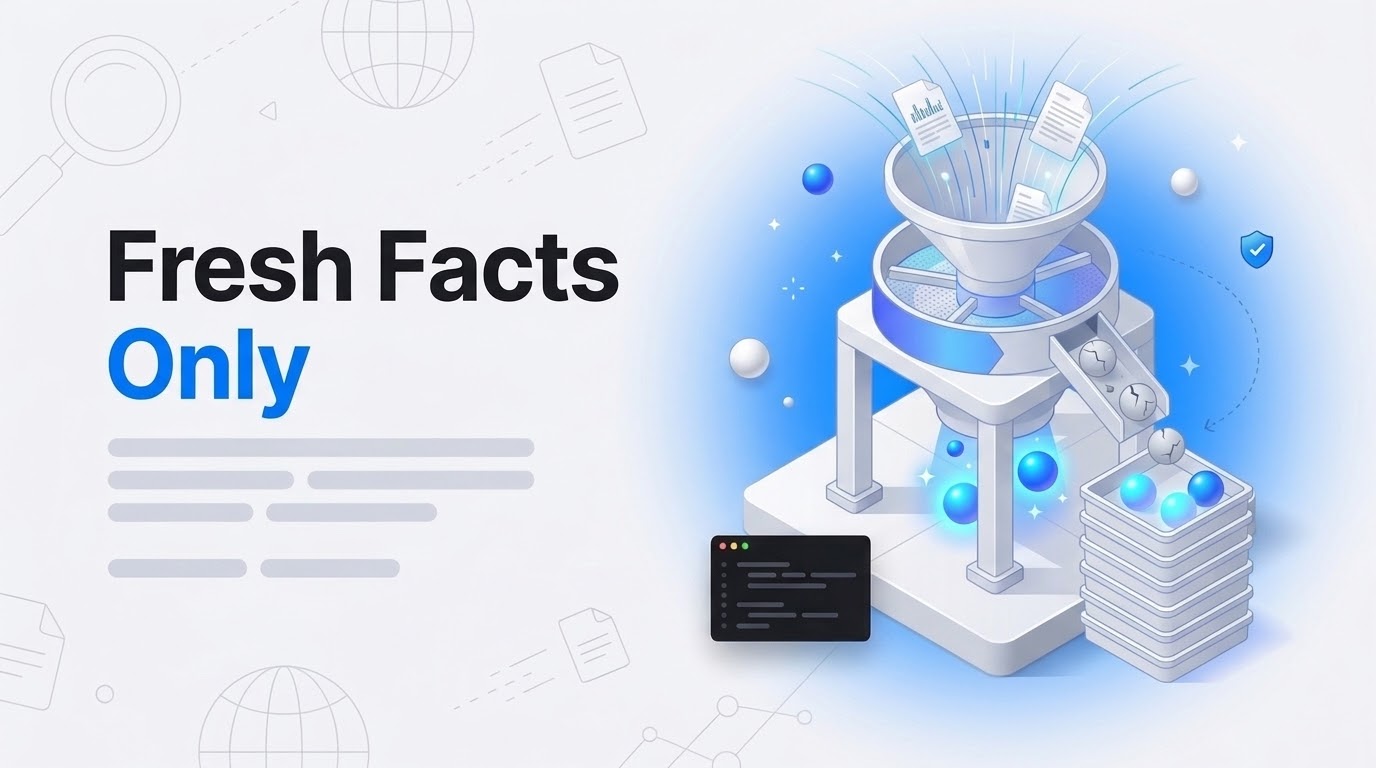
We need to talk about Grounding LLMs. The standard advice in the developer ecosystem has somehow become “just build a RAG pipeline,” and frankly, it’s producing some pretty stale results. If you build production AI tools, leaning only on static vector stores will bite you. Training data has cutoffs, and your customers don’t live in the past.
I’ve seen too many site owners frustrated because their expensive “AI Assistant” still thinks it’s 2023. The hallucinations aren’t happening because the model is “stupid.” It’s starved for fresh information. The fix is to ground your models with live web data.
Why RAG isn’t enough anymore
Retrieval-Augmented Generation (RAG) is great for searching your internal documentation or old PDFs. It falls apart the moment you need real-time facts, like changing competitor pricing, news, or the latest API changes. At that point your model starts guessing, and an ungrounded LLM delivers a wrong answer with exactly the same confidence as a right one.
What works is managed search infrastructure. Tools like SerpApi let your application fetch live search results and inject them into the prompt at runtime. That gives you a freshness layer a static vector database can’t.
If you’re already looking into this, my thoughts on WordPress AI integration trends cover where core is heading.
Designing the grounding pipeline
When you’re grounding LLMs, you’ll usually pick one of three patterns:
- Search-first: You always search the web before calling the LLM. It’s deterministic and easy to debug.
- Tool use: The model decides whether it needs the “Search Tool” based on how complex the query is.
- Agentic loops: The model searches, reads, and refines in a loop until the task is done. (High latency, but high accuracy.)
The naive approach vs. a better one
The naive way is to dump the raw search results into the prompt. You’ll hit token limits and confuse the model’s reasoning. A better approach extracts clean snippets and caches results in transients, which saves you a lot in API costs.
<?php
/**
 * Simple WordPress class for grounding LLMs with SerpApi.
 */
class bbioon_AI_Grounder {
    private $serp_api_key = 'YOUR_KEY';

    public function get_fresh_context( $query ) {
        // Check transient first to avoid redundant API calls (and race conditions).
        $cache_key = 'serp_cache_' . md5( $query );
        $cached = get_transient( $cache_key );
        if ( $cached ) return $cached;

        $response = wp_remote_get( "https://serpapi.com/search.json?q=" . urlencode( $query ) . "&api_key=" . $this->serp_api_key );
        if ( is_wp_error( $response ) ) return '';

        $data = json_decode( wp_remote_retrieve_body( $response ), true );
        $snippets = [];

        if ( ! empty( $data['organic_results'] ) ) {
            foreach ( array_slice( $data['organic_results'], 0, 3 ) as $result ) {
                $snippets[] = "Title: " . $result['title'] . "\nSnippet: " . $result['snippet'];
            }
        }

        $context = implode( "\n\n", $snippets );
        set_transient( $cache_key, $context, HOUR_IN_SECONDS );

        return $context;
    }
}
When you build these integrations, also avoid vendor lock-in. Don’t tie yourself to a single search provider or LLM.
Takeaway
Stop treating LLMs as if they know everything. They reason over whatever you feed them. Grounding LLMs with live data through a managed SERP API is the most efficient way I know to keep a production system from hallucinating on old data. Use transients to keep it fast, and keep your logic decoupled.
If Grounding LLMs work is eating your dev hours, I can take it on. I’ve been working with WordPress since the 4.x days, and I know how to make AI behave in production.
Ready to refactor?
If you’re ready to move past the demo phase, the OpenAI official docs have the latest on tool calling, and the LangChain SerpApi documentation covers more complex agentic patterns. Then ship it.


