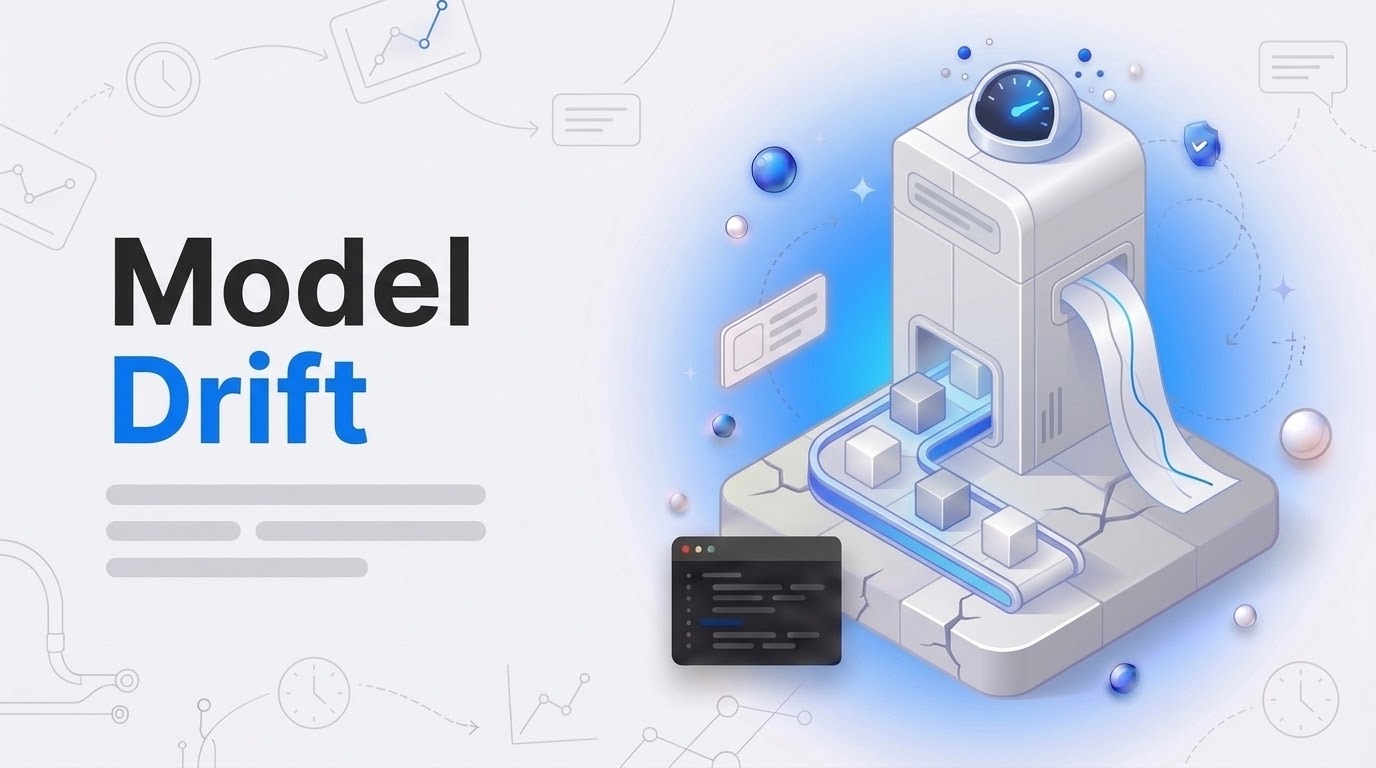
Clients who finally get AI into their stack tend to make the same mistake. Weeks go into training a recommendation engine or a churn predictor, they hit deploy, and they file the project under done. The decay starts the day the code hits production. Model drift is what quietly takes down enterprise AI, and without monitoring you are flying on an altimeter that stopped working weeks ago.
Fourteen years of wrestling with complex backends has taught me that production is messy and real data refuses to sit still. A model that tested at 95% accuracy can be down to 60% a few months later without anyone touching a line of your code. That is not a bug in your logic. The world moved and your model did not.
What model drift actually is
Model drift is the loss of predictive power that comes from the environment changing underneath a model. It says nothing about your training technique or the quality of your data gathering. A model is a snapshot of one particular reality, and when that reality shifts the snapshot stops being useful. Without metrics on a timeline you find out from a frustrated stakeholder telling you the recommendations are garbage.
1. Data drift (feature shift)
Data drift is when the statistical properties of your inputs change. Picture a WooCommerce site predicting customer lifetime value from height and weight. Data collection switches from imperial to metric, and now the model reads a 180cm person as 180 inches tall and starts forecasting for giants. The relationship it learned is intact. The data arriving just looks nothing like the training set.
2. Concept drift (relationship shift)
Concept drift is nastier because the data still looks fine. What changed is what the data means. I had a fraud detection model where the fraudulent patterns we identified during the POC were solid. Then the attackers evolved. They got so good at imitating normal user behavior that the model’s definition of fraud no longer described anything real. The link between the features and the target had moved.
Detecting drift before it breaks trust
Catching model drift comes down to boring, consistent monitoring. Plot AUC, precision and recall on a timeline and watch the shape. A gradual downward slope is your answer. The cheapest win is watching feature missingness: a sudden spike in NULL values usually means an upstream ETL change is starving the model of data.
If you run custom ML pipelines on the backend, a plain SQL check is enough to keep an eye on feature health in production:
-- Monitor feature health by checking for NULL spikes
SELECT
    DATE(prediction_time) as date,
    COUNT(*) as total_predictions,
    SUM(CASE WHEN feature_column_name IS NULL THEN 1 ELSE 0 END) as null_count
FROM bbioon_model_logs
GROUP BY 1
ORDER BY 1 DESC;
When null_count goes from 0.1% to 15%, you do not need a data scientist to interpret that. You need to go debug your data pipeline.
If drift work is eating your dev hours, hand it over. I have been wrestling with WordPress and messy data integrations since the 4.x days.
The final refactor
Deploy and forget is the trap. Fixing drift usually means one of two jobs: repair the data pipeline so it matches the format the model trained on, or retrain on a fresher slice of reality. If you want more on keeping systems fast under load, my guide on RAG pipeline optimization covers similar ground. Monitoring is what separates a cool demo from something you can leave running. Ship it, then keep watching the dashboard.


